By: Angie PowellHS 129, Summer 1 2009
The Beall Dawson house located in Rockville, Maryland is a “restored 1815 Federal style home furnished in period.” (Historical Marker Database). As seen in the picture, it is a two and a half story home that exhibits the life of Upton Beall, his wife, three daughters, and their slaves. In the museum today, “the daily life and culture of the Bealls and their slaves are presented along with displays related to the War of 1812, architecture, the early history of Montgomery County, tobacco farming and medicine.” (Planetware Travel Guide).

Upton Beall built the house in 1815 (Montgomery Historical Society). Today it is located at 103 West Montgomery Avenue in Rockville, Maryland, which is where these pictures were taken. Two of the pictures show the restored Beall Dawson house that was built in 1815 and the other picture talks about the slavery in Rockville before emancipation was issued in Maryland on November 1, 1864 (Historic Rockville African American Heritage Walking Tour). I took these pictures of May 28, 2009 for the purpose of learning more about slave life in Maryland and also for this project.
To find this historical site, I did a lot of searching on Google and found many web sites that listed multiple historical sites close to the Rockville area. I decided on the Beall Dawson house not only because of the convenience of location but also because it appealed to my interests. I was interested to see that slaves were passed down from generation to generation in the Beall family. Also, the Beall slave population did not increase because of buying and selling but because of birth from slaves which made them born into ownership by the Bealls (Historic Rockville African American Heritage Walking Tour).
What astonished me is the fact that it looked like a normal house that people might live in today. Knowing that the house was built in 1815 and even if it was restored, the condition it is in today is fantastic and is very interesting since the architecture is not so different to some houses today. What also attracted me to this historical site was the knowledge that slaves and people lived in this exact house less than 200 years ago which in and of itself is very impressive and almost unimaginable.
Knowing that I was standing on the same ground that slaves walked on and that I was at a place that added dimensions to slave life in Maryland was exhilarating and unbelievable. Today, I couldn’t imagine seeing slaves being put to work or being punished, but when I was at the Beall Dawson house I realized the enormous change the United States took after the Civil War and the emancipation of all slaves in the U.S. I am grateful that the U.S. has made life how it is today so all of us wouldn’t have to find out what being a slave or owning slaves would feel like.

The relationship of African American history to the Beall Dawson house is the presence of slaves. Upton Beall, a wealthy landowner and Clerk of Montgomery County Court in 1815, built the house in 1815. He owned 25 slaves which were split to work on one of his three estates: the Beall Dawson house, one of Beall’s mills in Watts Branch, or Beall’s rural property in Beallmont. After Upton Beall’s death in 1827, the ownership of slaves transferred to his wife and three daughters. Under the ownership of Mrs. Beall and her daughters the slaves “worked the land, cooked, cleaned, tended kitchen gardens, canned, washed, ironed, and cared for livestock” (Historic Rockville African American Heritage Walking Tour). After their mother’s death, the three daughters inherited the estates and slaves which by 1853 that had 40 and by 1860 they had 52.
The Beall sisters never sold or bought any slaves except for John Henson of whom they sold to Josiah Henson, assumed to be John Henson’s brother, for $250. Josiah Henson was a famed fugitive slave who is known as Harriet Beecher Stowe’s prototype in her book Uncle Tom’s Cabin. His family was sold and in 1830 he escaped his master with his wife and four children where he then helped over a hundred slaves escape, including his brother John Henson (Josiah Henson: Biography from Answers.com).
The growth of slaves happened because of births within the slave population that the Bealls already owned. The majority of their slaves lived in quarters on the three estates, while some slaves were hired out to families in D.C. In 1862, the Beall sisters freed the 17 slaves who worked in D.C. and received “$9400 for them under a federal compensation program.” (Historic Rockville African American Heritage Walking Tour). The Beall sisters freed the rest of the slaves on November 1, 1864 when emancipation was declared in Maryland. After the freeing of their slaves, the Beall’s sold some of their land to the free slaves and other African American families. Not much is known about what the Beall slaves did after they were free but we can generalize that some went to work in their skilled practices while others went on to raise families because many of the Beall slaves weren’t treated harshly and were able to become skilled workers.
The Beall Dawson house is an interesting historical site that future generations should take time to visit. They will be able to gain knowledge about what slaves did in and around the Beall Dawson house. In the house, slaves were under closer supervision by the Beall sisters and therefore probably worked harder and were more stressed. House duties included cooking, cleaning, washing, and ironing. The slaves who worked outside worked the land, tended kitchen gardens, canned, and cared for livestock (Historic Rockville African American Heritage Walking Tour).
The museum portrays the lives of these slaves as always working but not intensely working as in other places like southern plantations. From what I read, it seems as if we can generalize that the slaves were still treated as inferior by the sisters and had to live above the kitchen or in small slave quarters on the field, but conditions on the Beall Dawson house and fields was nowhere near as harsh or cruel as in other places in the Deep South. Future generations will enjoy the knowledge incorporated within and around this house and may bring to them an understanding of how slave life was in Maryland.

While visiting this historical site may be interesting and knowledgeable, future generations should keep in mind that it may be haunted. The Beall-Dawson house is a pre-Civil War house that survived through the presence of General Jeb Stuart’s Confederate troops and the invasion of General George McClellan’s Union Army (HAUNTED MARYLAND).
Not much is known about the haunting activity around and in the Beall Dawson house but a ghostly apparition has been seen in the house. It could have been Upton Beall, his wife Jane Beall, one of their three daughters Jane, Mathilda, and Margaret, or one of the six to eight household slaves that lived in the main house (Paranormal Everything). Since the house has been declared haunted, I warn all people to beware of visiting the site at night and encourage them to visit during the day because although it may be haunted, it is a great experience that introduces people to slave live in this area. However, if you wish to be daring, the Beall Dawson House offers ghost tours every Halloween (HAUNTED MARYLAND).
Works Cited:"African American Historic Sites in Montgomery County, Maryland." Google Maps. 28 May 2009.
"Beall-Dawson House, Rockville." PlanetWare Travel Guide - Hotels, Attractions, Pictures, Maps & More. 28 May 2009.
Fuchs, Tom. "Beall-Dawson House and Park Marker." The Historical Marker Database. Ed. J. J. Prats. 5 Apr. 2006. 28 May 2009.
"Historic Rockville African American Heritage Walking Tour." Rockville, Maryland - Official Web Site. 28 May 2009.
"Josiah Henson: Biography from Answers.com." Answers.com - Online Dictionary, Encyclopedia and much more. 16 June 2009.
Paranormal Everything - paranormall.org. 16 June 2009
"Rockville Campus, Beall-Dawson Historic Park." Montgomery Historical Society. 28 May 2009.


 The school is a one-room 22 x 30 foot wooden building, heated by a wood stove. This school served as the only public school for African Americans in the Boyds area from 1895-1936. The schoolhouse served students in grades 1-8, many of whom walked for miles to attend classes at the school. The school was purchased in 1980 by BHS (Boyds Historical Society), the school was then restored to its original condition in approximately 1900.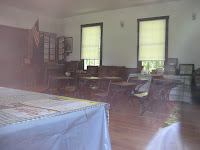
 Boyds Historical Society was organized in 1975 (as the Boyds/Clarksburg Historical Society). Their membership consists of local residents who share an interest in preserving the community's history. The Boyds Historical Society has done many things for the Boyds Community today which makes it very important for future generations to know to keep the BHS going. They have established an archive and museum facility for the community. They have preserved the Boyds Negro School as a Maryland Historic Site and they promote and encourage activities that educate, entertain, and develop community fellowship. They also provide space for community functions, events and festivals. This is just an overall great place for the community and is a great place to remember.


 When a new Blockbuster Video opened across the street from the Dee’s Shop it forced her to shift her efforts to her beauty supplies. This move proved to be a smart business choice as there were few other beauty supply areas to compete with. Although there were many commercial hair products on the market, Dee’s Beauty Supply and Salon, allows African Americans to locate products specifically created for their hair. It was not until Dee opened a salon within the shop that her business truly began to flourish. This provided a convenient place for my sisters as well as other local women to get their hair washed and styled. In 2007 Dee was able to expand her business by opening another beauty supply and salon shop in Gaithersburg, Maryland.
 Dee’s Beauty Supply and Salon not only shows how African Americans were able to make their way in today’s business world, but how they were able to improvise as well as adapt in order to survive. In many ways, it resembles our days as a people trying to survive in this country’s founding years.


 I was interested in visiting this site because it is very well-known throughout the country because Harriet Beecher Stowe wrote a novel based on the autobiography of Josiah Henson (Maryland Historical Trust). Future generations should realize the importance of the Riley House. This house is a great part of American literature of the 19th century. The novel written that takes place at the Riley House was the second most purchased book in the United States. The only book to sell more copies was the Bible (Book Rags). Future generations should also realize that African-Americans lived as slaves here in Rockville. It’s hard to believe that we have come so far in civil rights since then. The fact that according to the Washington Post, Montgomery County spent one million dollars to purchase the Riley House proves that Maryland is very interested in preserving African-American history.


 I say “physically” because after Africans or Indians were taken from their homes they were put on ships that they called slavers. These ships transported slaves around the world, to many different locations. The slaves, who actually made it off the ship without dying from disease, ended up being owned by other people, the way we own our animals today. Unfortunately, I am not done yet; their experiences did not get any better for a long time. The slaves ended up working all day long and sometimes right through the night depending on what kind of work they were told to do by their masters. (Fieldwork, housework, watching kids, cleaning, cooking, etc...) The slaves had bad living situations, too. they lived in these little shacks some with dirt floors, of course not much furniture at all, and sometimes not even a bed to sleep on.
 The wood on the log cabin was dated back to about 1850. This log cabin is what the Africans Americans both enslaved and freed would live in. Sometimes, families of ten to twelve people would live in this cabin all at once. You could imagine the struggles the slaves had to deal with. For example, they had to live in something that is no bigger than a
  Slaves were here, standing on the same ground that we are standing on today. Imagine standing in the same place and going back two three and four hundred years. This cabin housed people in what is now Olney, Maryland. The slaves that would have lived in this exact log cabin were probably tobacco farmers because remember the Chesapeake colonies (Virginia, Maryland before it expanded) were big on tobacco. That was their main form of profit in the late 1850’s and that is about the time that the cabin was built.


 Posts
Posts

